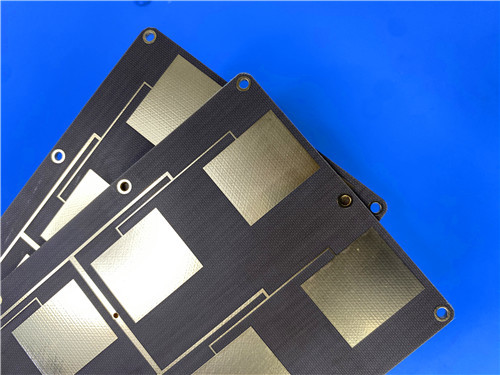
Le PCB TLX-9 – 10 mil, EPIG (sans nickel) pour une domination haute fréquence
Dans le monde de l'ingénierie RF et micro-ondes, le substrat n'est pas seulement un support physique pour le cuivre : il est au cœur du jeu d'intégrité du signal. Lorsque vous avez besoin d'un contrôle diélectrique strict, d'une perte de signal minimale et d'une finition de surface qui ne ruinera pas votre impédance, vous arrêtez de vous tourner vers la norme FR-4.
Entrez leCarte PCB TLX-9(10 mil, EPIG sans nickel). Il s'agit d'un panneau rigide à 2 couches conçu pour les applications où l'absorption d'humidité et la stabilité de la constante diélectrique (DK) ne sont pas négociables.
Décomposons les spécifications, l'empilement et pourquoi cela est important pour votre prochain LNA, antenne ou amplificateur haute puissance.
La Fondation : Taconic TLX-9
La star de cette construction est leTLX-9stratifié. Il s’agit d’un composite PTFE/verre tissé. Contrairement aux matériaux RF standard qui dérivent avec la température ou l'humidité, le TLX-9 est un véritable bourreau de travail.
- Constante diélectrique (DK) :2,5 à 10 GHz (étroitement contrôlé en fréquence/température)
- Facteur de dissipation (Df) :0,0019 à 10 GHz
- Absorption d'humidité :<0,02% (pratiquement zéro lors de la fabrication)
Pourquoi est-ce important ? Un Df de 0,0019 signifie une perte d'insertion incroyablement faible. L'absorption d'humidité <0,02 % signifie que votre déphasage ne changera pas la semaine prochaine en raison du changement de temps. Ce matériau détient également unUL94V-0indice d'inflammabilité, de sorte que la sécurité n'est pas sacrifiée au profit de la performance.
La construction : minimaliste mais puissante
Il s’agit d’une conception rigide à 2 couches, sans fioritures et hautes performances. Découvrez le stackup :
- Couche supérieure :Cuivre 35 µm (1 oz)
- Cœur:Taconique TLX-9 – 0,254 mm (10 mils)
- Couche inférieure :Cuivre 35 µm (1 oz)
Détails du tableau :
- Dimensions:91,6 mm x 45,3 mm (±0,15 mm)
- Épaisseur:Finition de 0,3 mm (c'est très fin, idéal pour les boîtiers étroits ou les applications flexibles).
- Trace/Espace :5/6 mils (assez serré pour un routage RF dense).
- Taille minimale du trou :0,3 mm (perceuse mécanique standard).
- Par placage :20 µm (assez robuste pour la fiabilité).
Notamment absents :Il y aNonmasque de soudure en haut ou en bas, etNonsérigraphie. C'est intentionnel. Pour les conceptions haute fréquence, le masque de soudure ajoute des pertes et des variations de phase imprévisibles. Une surface en cuivre nu et en PTFE est souvent supérieure.
La finition : Pourquoi EPIG (sans nickel) ?
Cette planche utiliseEPIG (Or par immersion au palladium électrolytique), plus précisément leSans nickelvariante.
La norme ENIG utilise une couche barrière au Nickel. Le nickel est ferromagnétique et entraîne des pertes aux hautes fréquences. En supprimant le Nickel et en utilisant EPIG, vous obtenez :
- Or(pour la soudabilité et la résistance à la corrosion)
- Palladium(comme barrière de diffusion)
- Aucune perte magnétiquedans vos chemins RF.
Il s'agit de l'étalon-or (jeu de mots) pour les cartes RF où chaque 0,1 dB de perte compte.
Statistiques PCB : simples mais fonctionnelles
L'examen de la netlist et du nombre de pads confirme qu'il s'agit d'un circuit RF ciblé, et non d'une carte mère numérique complexe.
- Composants :29
- Total des tampons :45
- Tampons traversants :24 (probablement pour les connecteurs ou les composants RF traversants)
- Meilleurs tampons SMT :21
- Tampons SMT inférieurs :0 (Tous les composants sur la face supérieure)
- Via :19
- Filets :2 (Essentiellement un seul chemin RF plus la terre. Très propre).
Performances thermiques et mécaniques
Les composants RF deviennent chauds. Le TLX-9 le gère bien :
- Conductivité thermique :0,19 W/m/K (respectable pour le PTFE).
- ETC (xy) :9-12 ppm/°C (correspond bien au cuivre : bonne fiabilité pendant les cycles thermiques).
- CTE (axe z) :130-145 ppm/°C (standard pour le PTFE ; assurez-vous que vos trous traversants plaqués sont robustes).
- Résistance au pelage :12 lb/pouce linéaire (1 oz de cuivre). Vous ne souleverez pas facilement les coussinets.
C'est pour qui ? (Applications typiques)
Basée sur les propriétés du TLX-9, cette carte est conçue pour :
-
LNA, LNB, LNC(Blocs/convertisseurs à faible bruit) – Là où un faible bruit et un gain stable sont essentiels.
-
Antennes grand format PCS/PCN(Service de communications personnelles/réseau) – Le 2,5 DK permet un réglage d'antenne prévisible.
-
Amplificateurs haute puissance– Le claquage diélectrique élevé (>60 kV) et les faibles pertes garantissent l’efficacité.
-
Composants passifs(Coupleurs, filtres, diviseurs) – Le DK étroitement contrôlé garantit que votre fréquence centrale ne s'égare pas.
Qualité et disponibilité
- Norme de qualité :IPC-Class-2 (Norme pour le matériel RF commercial ; permet des imperfections esthétiques mineures mais garantit la fonctionnalité électrique).
- Essai:Test 100% électrique avant expédition.
- Oeuvre :Gerber RS-274-X (norme industrielle).
- Disponibilité:Mondial.
Le verdict
Si vous concevez un récepteur frontal sensible ou une chaîne de transmission haute puissance dans la gamme GHz, leTLX-9 10mil EPIGLe panneau élimine trois maux de tête majeurs : la dérive d'humidité, la perte induite par le nickel et la tolérance DK.
Il s'agit d'une planche minimaliste (2 couches, sans masque, sans soie) conçue pour des performances RF maximales. Attention : avec une épaisseur totale de 0,3 mm et aucun masque de soudure, vous aurez besoin d'un processus d'assemblage minutieux. Mais pour les puristes de l’intégrité du signal ? C'est un rêve.
Aperçu des spécifications :
- Matériel:Taconic TLX-9 (PTFE/verre tissé)
- Finition:EPIG (sans nickel)
- NSP/Df :2,5 / 0,0019 à 10 GHz
- Épaisseur:0,3 mm
- Poids Cu :1 oz de couches extérieures
Prêt à dépasser le FR-4 ? Ceci est votre tableau.


 Votre message doit contenir entre 20 et 3 000 caractères!