



Laminat haute fréquence TFA300: Guide complet d'ingénierie avec propriétés, étude de cas de conception de PCB et applications
ContPerson : Sally Mao
Numéro de téléphone : 86-755-27374847
Je suis désolé. : +8618277967574
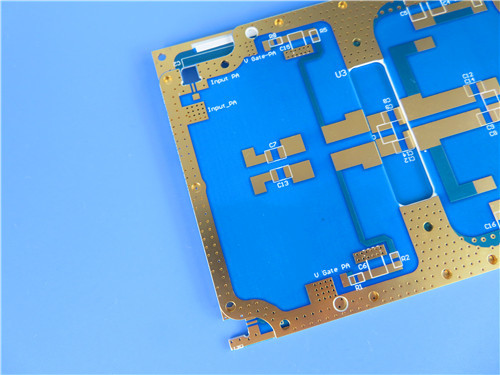
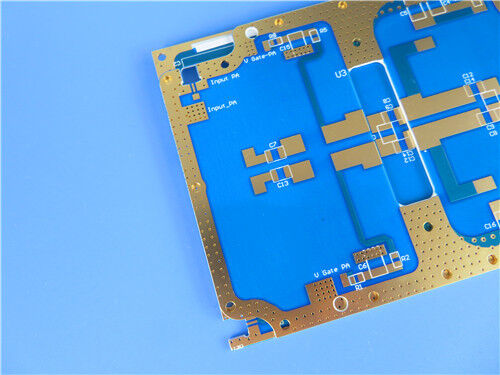
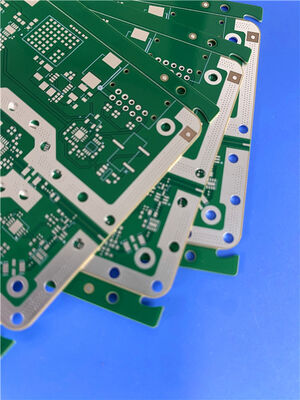
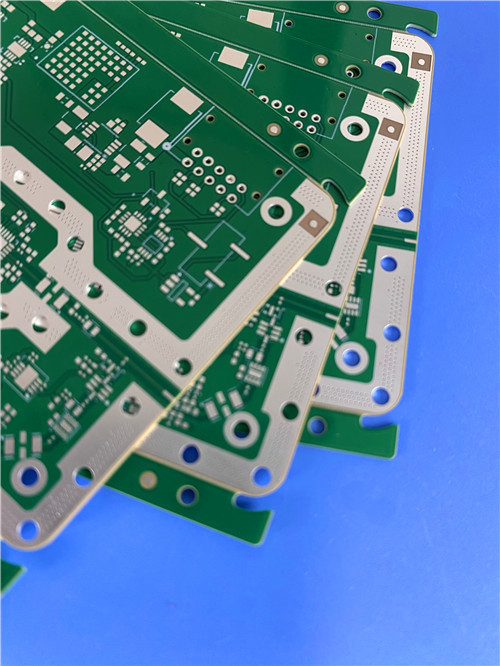
| Lieu d'origine: | Chine | Nom de marque: | Rogers |
|---|---|---|---|
| Certification: | ISO9001 | Numéro de modèle: | CuClad 250 |
Description de produit
Qu'est-ce que le CuClad 250?
CuClad 250 est un stratifié composite en fibre de verre/PTFE fabriqué par Rogers Corporation. Il présente une plage de constante diélectrique de 2,40 à 2,55 à 10 GHz, un facteur de dissipation de 0,0017 à 10 GHz,et une construction unique en plis croisés où les couches alternantes de fibres de verre sont orientées 90° les unes vers les autres. Cela fournit une véritable isotropie électrique et mécanique dans le plan XY une caractéristique inégalée par d'autres stratifiés en PTFE tissés ou non tissés.CuClad 250 offre des propriétés mécaniques proches de celles des substrats classiques, ce qui le rend idéal pour les filtres, les accouplements, les amplificateurs à faible bruit et les antennes phasées.
Les points essentiels (d'un coup d'œil)
Dk (10 GHz): de 2,40 à 2.55
Facteur de dissipation: 0,0017 @ 10 GHz
TEC (X/Y/Z): 18 / 19 / 177 ppm/°C (0°C à 100°C)
Conductivité thermique: 0,25 W/m·K
Absorption de l'humidité: 0,03%
Résistance à l'écaillage: 14 lb/in (après contrainte thermique)
L'équipement doit être équipé d'un dispositif d'échange de données.
Dégazage par la NASA: TML 0,01%, CVCM 0,00%, WVR 0,00%
Différenciateur clé: la construction en fibre de verre tissée en plis croisés fournit une véritable isotropie XY ∼critique pour les applications d'antenne à matrice phasée
1Pourquoi choisir CuClad 250?
Pour les ingénieurs qui conçoivent des circuits à haute fréquence, la sélection des matériaux affecte non seulement les performances électriques, mais aussi la stabilité mécanique et la fabrication.Le CuClad 250 répond à ces exigences grâce à quatre avantages clés:
Véritable isotropie XY L'avantage du pliage croisé: Les stratifiés CuClad sont pliés croisés, ce qui signifie que les couches alternantes de couches de fibres de verre revêtues sont orientées à 90 ° les unes vers les autres.Cela fournit une véritable isotropie électrique et mécanique dans le plan XY, une caractéristique unique aux stratifiés CuCladAucun autre stratifié PTFE renforcé de fibre de verre tissé ou non tissé ne peut faire cette affirmation.
Stabilité dimensionnelle supérieure: avec un rapport fibre de verre/PTFE plus élevé, CuClad 250 offre des propriétés mécaniques proches de celles des substrats classiques.Une meilleure stabilité dimensionnelle et une plus faible expansion thermique dans toutes les directions sont des avantages importants, en particulier pour les dessins et modèles nécessitant un enregistrement strict et un traitement des caractéristiques.
Constante diélectrique constante: The precision control of the PTFE-to-fiberglass ratio allows Rogers to offer a greater variety of dielectric constants and produces a laminate with better dielectric constant uniformity than comparable non-woven fiberglass reinforced laminates.
fiabilité de qualité aérospatiale: avec des valeurs de dégazage de la NASA (TML 0,01%, CVCM 0,00%, WVR 0,00%) et une conformité UL 94 V-0,Le CuClad 250 répond aux exigences strictes des applications spatiales et avioniquesPour les applications de performance critique, les produits CuClad peuvent être spécifiés avec une qualité d'essai "LX", où chaque feuille est testée individuellement et un rapport d'essai est délivré avec la commande.
2Propriétés du CuClad 250
Le tableau ci-dessous regroupe toutes les spécifications électriques, mécaniques, thermiques et physiques du CuClad 250 telles qu'elles sont fournies dans la fiche officielle.Toutes les valeurs représentent des données de mesure typiques et sont destinées à faciliter la sélection des matériaux..
| Les biens immobiliers | Méthode d'essai | Condition | CuClad 250 |
| Constante diélectrique @ 10 GHz | IPC TM-650 2. Les produits de base sont les suivants:5.5.5 | C23/50 | 2.40 contre 2.55 |
| Constante diélectrique @ 1MHz | IPC TM-650 2. Les produits de base sont les suivants:5.5.3 | C23/50 | 2.40 contre 2.60 |
| Facteur de dissipation @ 10 GHz | IPC TM-650 2. Les produits de base sont les suivants:5.5.5 | C23/50 | 0.0017 |
| Coefficient thermique de l'Er (ppm/°C) | IPC TM-650 2. Les produits de base sont les suivants:5.5.5 Adapté | -10°C à +140°C | -153 |
| Résistance à l'écaillage (lbs par pouce) | IPC TM-650 2. Les produits de base sont les suivants:4.8 | Après un stress thermique | 14 |
| Résistance au volume (MΩ-cm) | IPC TM-650 2. Les produits de base sont les suivants:5.17.1 | C96/35/90 | 8.0 × 10⁹ |
| Résistance de surface (MΩ) | IPC TM-650 2. Les produits de base sont les suivants:5.17.1 | C96/35/90 | 1.5 × 10⁸ |
| Résistance à l'arc (secondes) | Pour l'utilisation dans les machines à coudre | D48/50 | > 180 |
| Module de traction (kpsi) | Pour l'aéronef | A, 23°C | 725, 572 |
| Résistance à la traction (kpsi) | Pour l'utilisation dans les machines à coudre | A, 23°C | 26.0- Je vous en prie.5 |
| Module de compression (kpsi) | Pour les appareils de traitement de l'air | A, 23°C | 342 |
| Module de flexion (kpsi) | Pour l'aéronef | A, 23°C | 456 |
| Décomposition diélectrique (kV) | Pour l'utilisation dans les machines à coudre | D48/50 | > 45 |
| Gravité spécifique (g/cm3) | ASTM D-792 Méthode A | A, 23°C | 2.31 |
| Absorption de l'eau (%) | Le produit doit être présenté sous forme d'un produit chimique.7.7 / IPC TM-650 2.6.2.2 | E1/105 + D24/23 | 0.03 |
| Coefficient de dilatation thermique X axe (ppm/°C) | IPC TM-650 2. Les produits de base sont les suivants:4.24 / Mettler 3000 TMA | 0°C à 100°C | 18 |
| Coefficient de dilatation thermique | IPC TM-650 2. Les produits de base sont les suivants:4.24 / Mettler 3000 TMA | 0°C à 100°C | 19 |
| Coefficient de dilatation thermique | IPC TM-650 2. Les produits de base sont les suivants:4.24 / Mettler 3000 TMA | 0°C à 100°C | 177 |
| Conductivité thermique | Pour l'utilisation dans les machines à coudre | 100°C | 0.25 |
| Dégazage Perte de masse totale (TML) (%) | Les données sont fournies par la NASA SP-R-0022 | 125°C, ≤ 10−6 torr | 0.01 |
| Dégazage CVCM (%) | Les données sont fournies par la NASA SP-R-0022 | 125°C, ≤ 10−6 torr | 0 |
| Dégagement de gaz ️ Récupération de la vapeur d'eau (WVR) (%) | Les données sont fournies par la NASA SP-R-0022 | 125°C, ≤ 10−6 torr | 0 |
| Dégagement de gaz Condensat visible (±) | Les données sont fournies par la NASA SP-R-0022 | 125°C, ≤ 10−6 torr | - Je ne sais pas. |
| Intégrabilité | UL 94 Brûlure verticale / IPC TM-650 2.3.10 | C48/23/50, E24/125 Le produit est présenté sous forme de | Répond aux exigences de la norme UL94-V0 |
3Stabilité de fréquence du CuClad 250
CuClad 250 démontre une excellente stabilité de la constante diélectrique à travers la fréquence, comme le confirment les mesures de l'espace libre et de la cavité du résonateur circulaire.Cette caractéristique démontre la robustesse inhérente des stratifiés Rogers à travers le spectre EM, simplifiant le processus de conception final lors du travail sur différentes fréquences.La stabilité de la constante diélectrique assure une transition facile de la conception et une évolutivité de la conception, un avantage important pour les ingénieurs qui développent des systèmes multibande ou large bande.
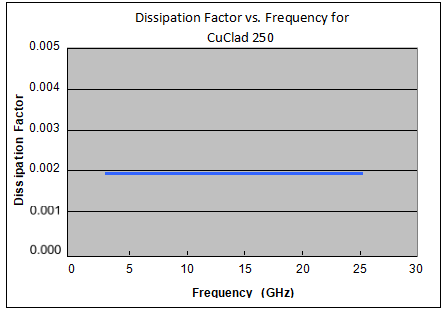
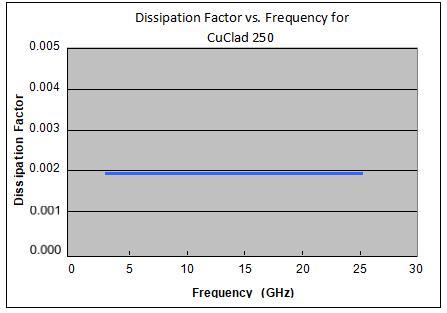
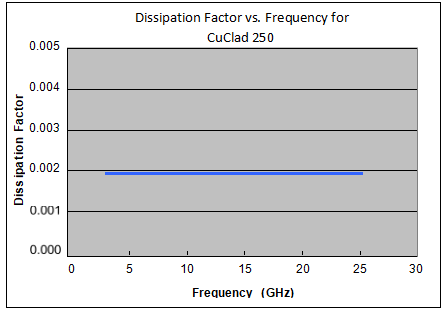
Facteur de dissipation par rapport à la fréquence de CuClad 250:
Note: le facteur de dissipation reste exceptionnellement bas dans toute la gamme de fréquences,avec seulement une légère augmentation à des fréquences plus élevées, confirmant l'adéquation du CuClad 250 pour les applications à large bande et à ondes millimétriques.
4Disponibilité du matériel
Pour les pièces d'un type ou de plusieurs types:
Standard: 1/2 oz, 1 oz ou 2 oz de cuivre déposé par électrodeposition des deux côtés
Facultatif: Autres poids en cuivre et feuille de cuivre laminée disponibles
Options avec support métallique: lié à des plans de terre en métaux lourds (plaques en aluminium, laiton ou cuivre) pour un captage thermique intégré et un support mécanique
Tailles de panneau standard:
Taille de la feuille principale: 36" × 36" en configuration croisée
Autres tailles disponibles sur demande
Informations sur les commandes:
Lors de la commande du CuClad 250, veuillez préciser:
Constante diélectrique
Épaisseur
Le revêtement (poids et type de cuivre)
Taille du panneau
Toutes les considérations particulières (par exemple, note d'essai "LX")
5. Étude de cas de conception de PCB de la spécification à la réalité
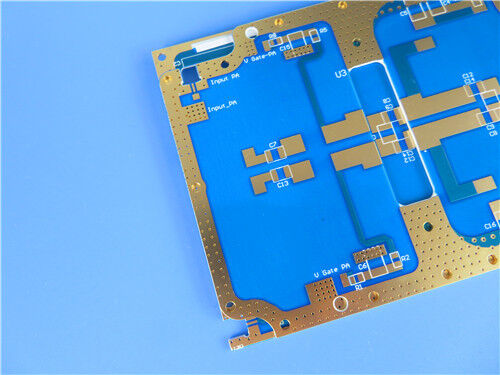
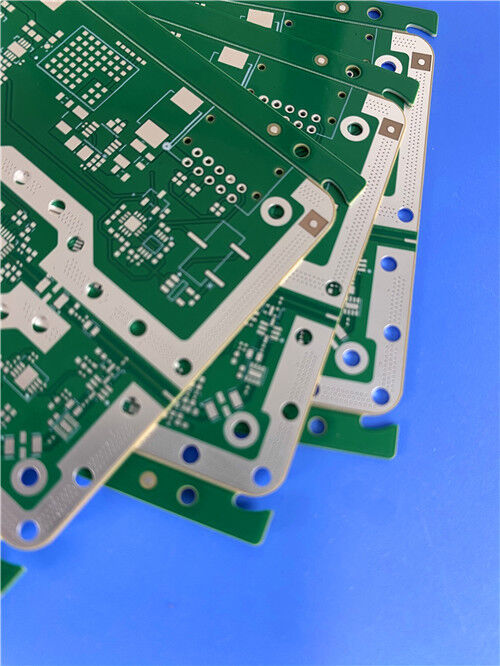
Pour illustrer comment CuClad 250 fonctionne dans un design réel, voici un exemple de carte à 2 couches avec une épaisseur de finition de 0,4 mm.
Spécifications de conception des PCB
| Paramètre | Spécification |
| Matériau de base | Rogers CuClad 250 |
| Nombre de couches | 2 |
| Dimensions du tableau | 48Pour les appareils à commande numérique: |
| Épaisseur du panneau fini | 0.4 mm |
| Le dépôt de PCB | Cu (35 μm) / CuClad 250 Core (0,254 mm / 10 mil) / Cu (35 μm) |
| Trace minimale / espace | 4 / 6 millilitres |
| Taille minimale du trou | 0.3 mm |
| Les voies aveugles | Aucune |
| Poids du cuivre fini (couches extérieures) | 1 oz (35 μm / 1,4 ml) |
| Via épaisseur de revêtement | 20 μm |
| Finition de surface | L'or par immersion (ENIG) |
| Le haut de la sérigraphie | Blanc |
| Vêtements de soie de fond | Aucune |
| Masque de soudure supérieur | Le bleu |
| Masque de soudure inférieure | Aucune |
| Norme de qualité | Classe IPC-2 |
| Tests | Test électrique à 100% |
| Format de l'œuvre | Le Gerber RS-274-X |
| Disponibilité | Dans le monde entier |
Rationalisation technique des spécifications clés:
| Paramètre | Rationalisation |
| CuClad 250 sélection | Choisie pour sa construction unique en plis croisés fournissant une véritable isotropie XY, une Dk constante (2,40 ∼2,55) et un faible Df (0,0017) ∼critique pour les circuits sensibles à la phase tels que les filtres et les coupleurs. |
| 0.4 mm épaisseur finie | Il est réalisé à l'aide d'un noyau CuClad 250 de 10 millimètres (0,254 mm); il prend en charge des conceptions compactes tout en maintenant la rigidité mécanique. |
| 4/6 millilitres Trace/Espace | Capacité de fonctionnalité fine rendue possible par la stabilité dimensionnelle du CuClad 250; prend en charge le routage RF et DC dense. |
| 0.3 mm Taille minimale du trou | Capacité de forage mécanique; pas besoin de laser ou de voies aveugles, ce qui simplifie la fabrication. |
| 1 oz de cuivre | Équilibre la capacité de transport de courant avec une capacité de gravure fine. |
| 20 μm par revêtement | dépasse le minimum de la classe 2 IPC; assure une fiabilité PTH robuste. |
| L'or par immersion (ENIG) | Fournit une surface plate et résistante à l'oxydation pour le soudage et le collage des fils. |
| La couche supérieure de sérigraphie (blanc) | Fournit des désignations de référence des composants pour l'assemblage; le blanc offre un bon contraste sur le masque de soudure bleu. |
| Masque de soudure supérieur (bleu) | Protège les circuits du côté supérieur; option de couleur bleue par préférence du client. |
| Pas de masque de soudure | Laisser à découvert pour des applications potentielles de mise à la terre ou de captage thermique. |
| Classe IPC-2 | Équilibre entre les coûts et la fiabilité pour les applications aérospatiales et télécoms commerciales. |
| Test électrique à 100% | Assure l'impédance, la continuité et l'isolation avant expédition. |
Note de fabrication essentielle pour le CuClad 250:
Forage: la construction en fibre de verre tissée du CuClad 250 nécessite des forages en carbure tranchants avec des vitesses et des taux de rétraction optimisés.contribuant à nettoyer les parois des trous et à réduire la formation de taches.
Préparation de surface: pour les finitions ENIG ou autres, les techniques de préparation de surface PTFE standard s'appliquent.CF4/O2) est recommandé pour activer la surface en PTFE et assurer une forte adhésion du revêtement.
Stabilité dimensionnelle: le rapport fibre de verre/PTFE plus élevé et la construction en plis croisés offrent une stabilité dimensionnelle supérieure par rapport aux alternatives non tissées,Il est particulièrement utile pour les conceptions avec des composants à haute résonance (16 plaquettes SMT) et denses via champs..
6Comment le CuClad 250 se démarque
| Unele spectre | CuClad 250 (verres tissés à joints croisés) | Laminés de PTFE non tissés | PTFE tissé standard |
| Isotropie XY | Véritable isotropie constructions croisées | Commercialisé | Commercialisé |
| Stabilité dimensionnelle | Proportion de verre supérieure à supérieure | En bas | C' est bon! |
| Dk Uniformité | Excellent contrôle de précision PTFE/verre | Moins cohérente | C' est bon! |
| Constante diélectrique | 2.40 ¢2.55 | Variable | Variable |
| Facteur de dissipation | 0.0017 @ 10 GHz | Généralement plus élevé | Comparable |
| Correspondance avec les ETC | Expansion thermique inférieure dans toutes les directions | Expansion plus élevée de l'axe Z | Modérée |
| Une caractéristique unique | Construction en plis croisés (orientation à 90°) | Aucune | Aucune |
Note: La construction en couches croisées de CuClad 250 fournit une véritable isotropie électrique et mécanique dans le plan XY, caractéristique unique des stratifiés CuClad.Aucun autre stratifié à base de PTFE renforcé de fibre de verre tissée ou non tissée ne fait cette déclaration..
7. Applications typiques où CuClad 250 brille
Sur la base de son ensemble de propriétés et du cas de conception ci-dessus, le CuClad 250 est bien adapté pour:
Radars: antennes à réseau de phases, radars au sol et radars aériens
Contre-mesures électroniques (CEM): systèmes de guerre électronique (CEM) et de soutien électronique (ESM)
Composants des micro-ondes: amplificateurs à faible bruit (LNA), filtres, coupleurs et diviseurs de puissance
Communications par satellite: systèmes de communication spatiaux et terrestres
Aérospatiale et avionique: systèmes de navigation, altimètres et équipements de communication
Antennes phasées: où la véritable isotropie XY est essentielle pour une réponse cohérente de phase et d'amplitude à travers les éléments du tableau
Q1: Qu'est-ce qui est unique à propos de la construction de CuClad 250?
Le CuClad 250 est doté d'une construction en plis croisés où des couches alternantes de couches de fibres de verre revêtues sont orientées 90° les unes vers les autres.Cela fournit une véritable isotropie électrique et mécanique dans le plan XY, une caractéristique unique aux stratifiés CuClad et critique pour les applications d'antenne à matrice phasée.
Q2: Quelle est la plage de la constante diélectrique pour CuClad 250?
À 10 GHz, le Dk varie de 2,40 à 2.55À 1 MHz, la portée est de 2,40 à 2.60Le contrôle précis du rapport PTFE/fibre de verre assure une excellente homogénéité Dk.
Q3: Le CuClad 250 est-il adapté aux applications aérospatiales et spatiales?
Oui. Avec des valeurs de dégazage de la NASA (TML 0,01%, CVCM 0,00%, WVR 0,00%) et une conformité UL 94 V-0, CuClad 250 répond aux exigences de la catégorie aérospatiale. Pour les applications critiques, la catégorie de test "LX" est disponible,où chaque feuille est testée individuellement et un rapport d'essai est délivré avec la commande.
Q4: Comment CuClad 250 fonctionne-t-il à travers la fréquence?
CuClad 250 démontre une excellente stabilité de la constante diélectrique à travers la fréquence.0023 à 30 GHz, confirmant son aptitude pour les applications à large bande et à ondes millimétriques.
Q5: Quelles options de cuivre et de panneaux sont disponibles?
CuClad 250 est fourni avec 1/2 oz, 1 oz ou 2 oz de cuivre déposé par électrodeposition des deux côtés.ou du cuivre) sont également disponibles pour le captage thermiqueLa taille de la feuille principale est de 36" × 36" en configuration croisée.
Q6: Quelles sont les finitions de surface compatibles avec CuClad 250?
L'or d'immersion (ENIG) est couramment utilisé, comme dans le cas de conception ci-dessus.ou OSP sont également compatibles avec une préparation de surface appropriée (traitement au plasma) avant la finition.
Q7: Toutes les valeurs du tableau des propriétés sont-elles garanties?
Les données fournies sont des valeurs mesurées typiques destinées à faciliter la sélection des matériaux et ne constituent ni limites de spécifications ni garanties.Les propriétés des stratifiés Rogers peuvent varier selon la conception et l'application.
Q8: Quelle est la note d'essai "LX"?
"LX" est une désignation de grade d'essai pour les applications critiques de performance. Lorsque spécifié, chaque feuille est testée individuellement et un rapport d'essai est délivré avec la commande.Les produits désignés "LX" sont plus chers, car une partie de chaque feuille est utilisée dans les essais destructeurs.
Conclusion
CuClad 250 de Rogers Corporation représente une solution unique et convaincante pour les ingénieurs qui conçoivent des circuits à haute fréquence qui exigent une véritable isotropie XY, des propriétés diélectriques constantes,et une excellente stabilité dimensionnelleComme le démontre le boîtier de conception de PCB à 2 couches, d'une épaisseur de 0,4 mm, de 4/6 mil/espace,et la finition en or par immersion CuClad 250 s'intègre facilement dans les processus de fabrication standard tout en offrant les performances électriques requises pour les radarsAvec sa construction croisée, CuClad 250 offre une caractéristique inégalée par tout autre stratifié en PTFE tissé ou non:isotropie électrique et mécanique vraie dans le plan XYPour les ingénieurs à la recherche d'un matériau fiable et performant pour les circuits sensibles aux phases et les applications aérospatiales, CuClad 250 est un choix fiable et éprouvé.
Entrez votre message

RO4350B, 4003C ; Rogers 5880, 5870, 6002, 6010, 6006, 6035 ; RO3003, RO3035, RO3006, RO3010, RO3210, RO3203
TLX-8, TLX-6, TLX-9, TLX-0, TLX-7, TLY-3, TLY-5, RF-35TC, RF-60TC, RF-35A2, RF-60A, AD450, AD600, TMM4, TC350
| Shenzhen Bicheng Electronics Technology Co., Ltd |
| ville de 6-11C Shidai Jingyuan Fuyong, secteur de Baoan, ville de Shenzhen, province du Guangdong, Chine |
| 86-755-27374946 |
| sales30@bichengpcb.com |